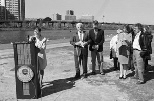
Officials from environmental organizations and MIT recently gathered on the banks of the Charles River to mark progress by the Clean Charles 2005 Coalition toward a swimmable and fishable river within five years. Speakers included Mindy S. Lubber (at podium), regional administrator at the EPA's New England office; Paul Parravano (second from left), co-director of MIT's Office Of Government and Community Relations; and Bob Zimmerman (third from left), exeutive director of the Charles River Watershed Association. Coalition member MIT has donated a boat to help with water sampling, and Dan Delisi, a graduate student in urban studies and planning, has been working with the EPA to design a stormwater-management ideas competition.
Credits:
Photo / Donna Coveney
Caption:
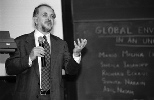
Institute Professor Mario Molina gives the keynote address at "Environment and Development in an Unequal World," an April 13 event that included a book release for Green Politics: Global Environmental Negotiations by the Center for Science and Environment in New Delhi, and a panel discussion with scientists from MIT and India. The event was sponsored by Sangam, PAKSMIT (the Pakistani Students Society at MIT), the Social Justice Cooperative, SAVE (Share a Vital Earth), AID-Boston, the Department of Earth, Atmospheric and Planetary Science's Mexico City Project and Boston University's Center for Energy and Environment Studies.
Credits:
Photo / Laura Wulf
A version of this article appeared in MIT Tech Talk on April 26, 2000.
Developed by MIT engineers, this flexible material could be used as a wearable, motion-monitoring “skin” in physical therapy, virtual reality, and gaming.
Over two decades at MIT, Hamilton forged new paths in computer science and engineering. Her groundbreaking work included leading the team that programmed the first computers that took humans to the moon.
Students in MIT’s Concourse program delve deeply into the human condition, debate challenging questions, and learn to develop judgment about issues that can’t be quantified.