
NSF renews support for MIT-led AI and physics institute, expanding a new model for discovery
IAIFI enters its second phase with increased funding, broader ambitions, and a growing community at the frontier of AI and fundamental physics.
IAIFI enters its second phase with increased funding, broader ambitions, and a growing community at the frontier of AI and fundamental physics.

Introducing weaker bonds into polystyrene and rubber helps these materials dissipate energy, making them more resistant to destructive forces.
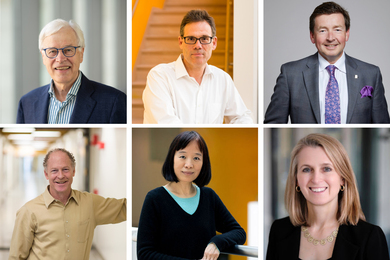
Six MIT faculty, along with 10 additional alumni, are recognized by their peers for their outstanding contributions to research in the natural and social sciences.

The legendary radio astronomy telescope returns to its science and educational mission at MIT Haystack Observatory.

Researchers can now use custom-built microscopy and nanotechnology to tag and follow the activity of individual proteins in real-time.
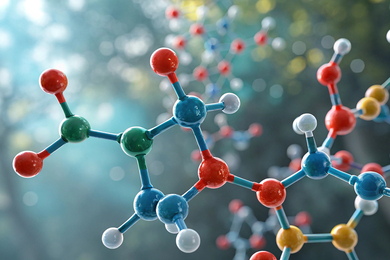
The discovery of dioxaborirane could expand the chemistry of boron-based reagents, providing new tools for oxidation reactions in synthesis and materials science.
Faculty members and researchers were honored in recognition of their scholarship, service, and overall excellence.

Fellowship honors contributions of immigrants to American society by awarding $90,000 in funding for graduate studies.

Rising seniors Deeksha Kumaresh, Anna Liu, and Charlotte Myers are honored for their academic achievements.
The prestigious honor society honors four MIT faculty and 13 additional MIT alumni among more than 250 new members.

Mitali Chowdhury ’24 and Christina Kim ’24 will pursue graduate studies at Cambridge University in the UK.
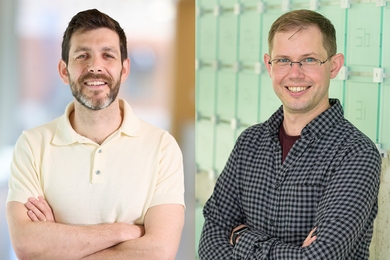
The associate professors of EECS and chemistry, respectively, are honored for exceptional contributions to teaching, research, and service at MIT.

Scientists say an exception in the Montreal Protocol for the use of ozone-depleting feedstocks could set the ozone recovery back seven years.

Long thought to be mainly a structural support, the cell membrane also influences how cells respond to signals and may contribute to the growth of cancer cells.

This new technique will allow chemists to efficiently fine-tune the chemical structure of an organic molecule.