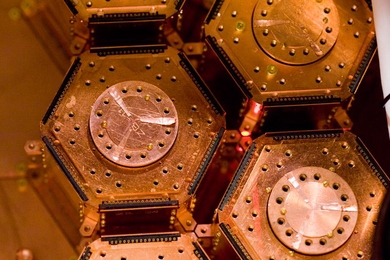
Closing in on dark matter?
Physicists detect two candidate dark matter interactions, but say the data are not conclusive.
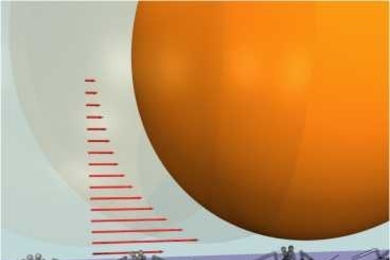
‘Micro-ants’: Tiny conveyor belts for the 21st century
A new method of moving tiny particles using magnetic polymer beads and magnetic fields could find uses in microchips and in medicine
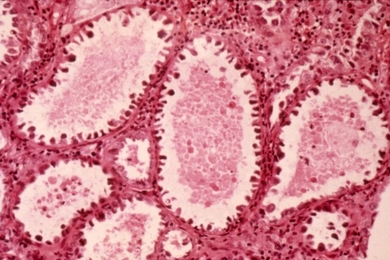
Cancer research gets physical
5-year grant from the National Cancer Institute will fund projects by physicists that give a new view of cancer cells.

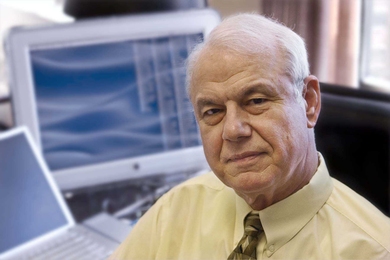
Porkolab to receive Maxwell Prize
Prof. Miklos Porkolab will receive the Maxwell Prize for Plasma Physics on November 4, during a meeting of the American Physical Society - Division of Plasma Physics.
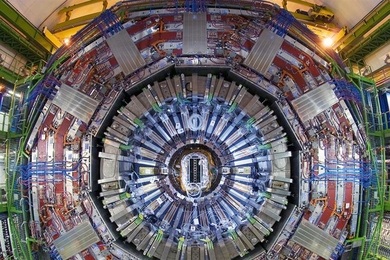
3 Questions: Steven Nahn on the elusive Higgs boson
Troubles at the Large Hadron Collider have led some physicists to suggest the Higgs boson is sabotaging its own discovery. Nahn explains why he disagrees.
Richard Yamamoto, physics professor, dies at 74
The particle physicist came to MIT in 1953 and spent his entire career at the Institute. A memorial service will be held on campus on Thursday, Oct. 29.
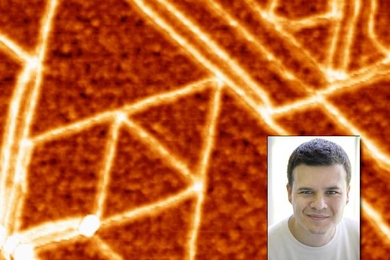
Physicist wins Packard Fellowship
Pablo Jarillo-Herrero will use the unrestricted funding to study materials that follow unusual rules of physics.
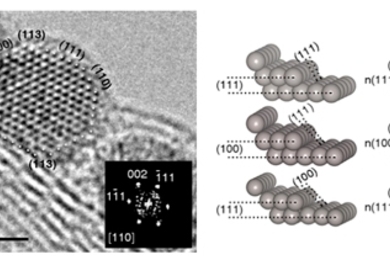
Fuel cells get a boost
Creating tiny steps to electrode surfaces can double the efficiency of the emissions-free electricity sources, MIT researchers find.

Quantum computing may actually be useful
A quantum algorithm that solves systems of linear equations could point in a promising new direction.
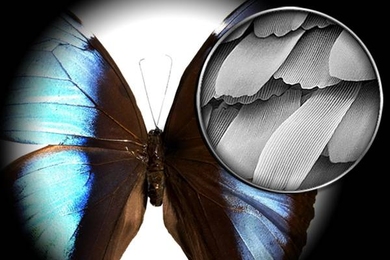
To peer inside a living cell
Quantum mechanics could help build ultra-high-resolution electron microscopes that won't destroy living cells, according to MIT electrical engineers.
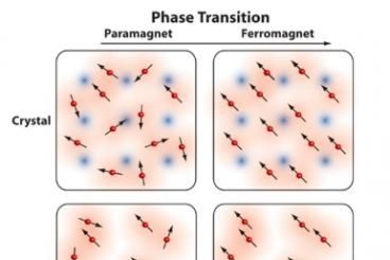
Magnetism observed in a gas for the first time
Led by Wolfgang Ketterle and David E. Pritchard, MIT physicists shed new light on magnetism in experiment with ultracold atoms
The hunt for dark matter
MIT physicists are working on new detectors that may, at last, help them find the elusive particles thought to constitute up to a quarter of the universe.